Thermal Imaging
Thermal Imaging is a method that detects infrared energy emitted by objects and converts it into a visible image. Because warmer surfaces release more infrared radiation than cooler ones, this technology can reveal temperature differences that are invisible to the naked eye.
Practical applications: Thermal imaging is widely used for building inspections, electrical maintenance, security monitoring, firefighting, and medical screening. It helps professionals identify heat loss, overheating equipment, moisture issues, and potential hazards quickly and without direct contact.
Thermogram
Most people have three types of color-detecting cones in their eyes and see roughly one million colors. Some rare individuals (primarily women) are born with a fourth cone type, potentially letting them perceive up to 100 million shades. Our biological limits restrict what we can physically experience.
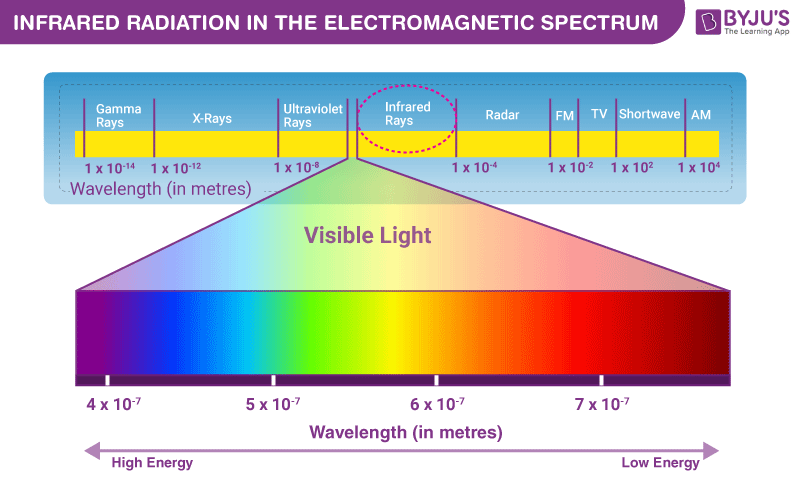
Infrared Spectrum is a band of electromagnetic radiation with wavelengths longer than visible red light but shorter than microwaves, generally spanning from 780 nm to 1 mm. All objects with a temperature above absolute zero emit infrared radiation. The warmer an object is, the more infrared energy it emits.
Examples:
- The Sun emits infrared light.
-
A campfire gives off large amounts of infrared radiation.
- Your body constantly emits infrared radiation.
Types of Infrared
Infrared is commonly divided into three regions:
-
Near-Infrared (NIR)
- Closest to visible light.
- Used in fiber-optic communications and remote controls.
-
Mid-Infrared (MIR)
- Used in chemical sensing and spectroscopy.
-
Far-Infrared (FIR)
-
Strongly associated with heat detection and thermal imaging.
-